
Digital Wills vs Digital Assets in England and Wales: The Essential Guide
August 26, 2026
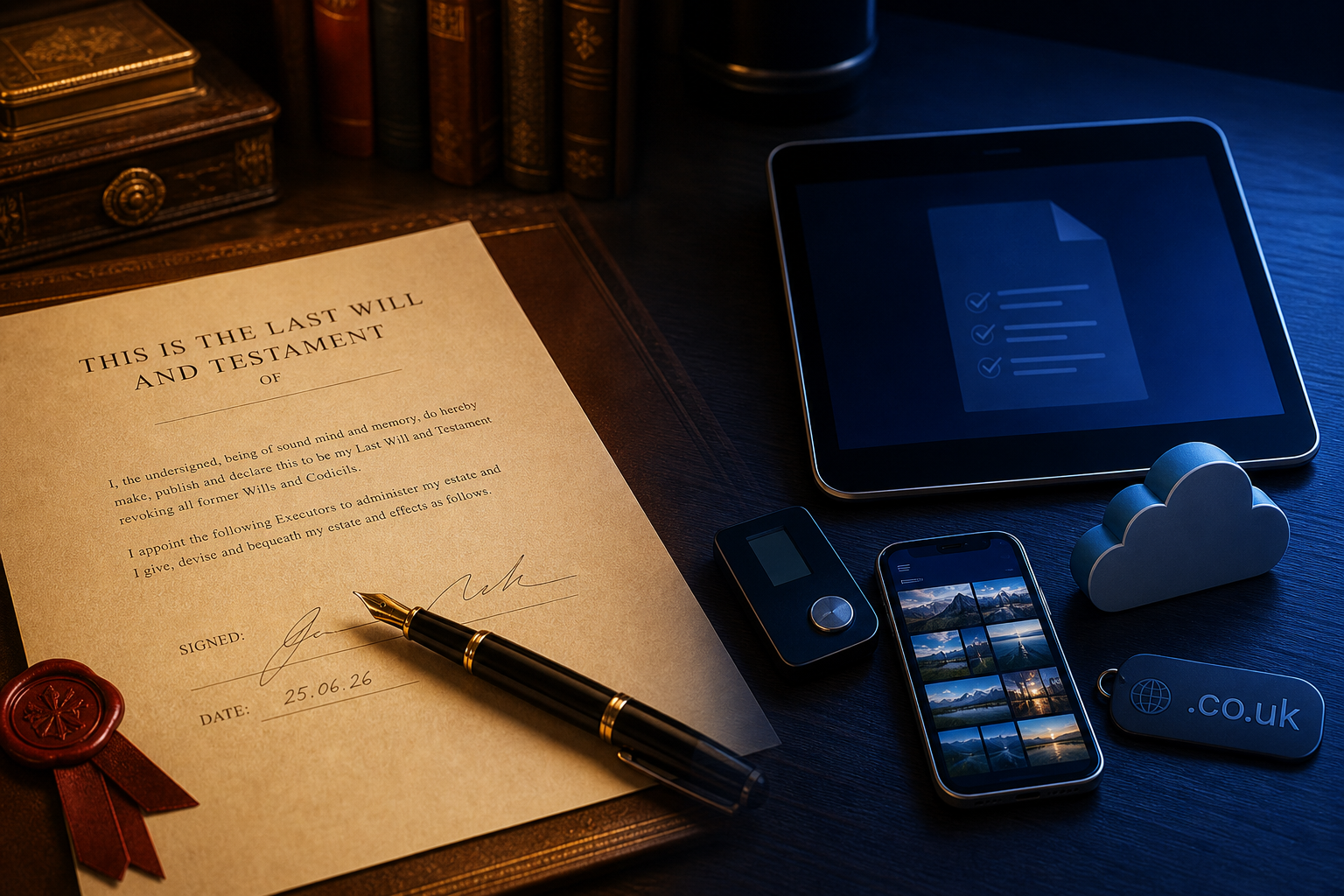
Two phrases turn up in the same conversation all the time now, and they describe completely different things. One is about how your Will gets made. The other is about what your Will has to cover. Confuse them, as a lot of careful people do, and you end up with a plan that has a hole in the middle of it.
The Quick Answer
A digital Will usually means writing your Will online. You can do that today. What you cannot do, under section 9 of the Wills Act 1837, is finish the job on screen: the document still has to be printed and signed in wet ink in front of two witnesses to be valid in England and Wales. A fully electronic Will, made and stored without paper ever entering the picture, needs new legislation that has not arrived.
Digital assets are a separate matter altogether. They are the cryptocurrency, online accounts, photo libraries, domain names, subscriptions and loyalty points that now make up a large part of an ordinary estate. Your paper Will can deal with them, and for most people that is the more pressing gap, because a Will that ignores them leaves the family to guess.
Why Digital Wills and Digital Assets Get Confused
The two get confused because both describe modernising something old, and a search for either term returns results about the other. The law on one of them is also under active review, which muddies it further.
Add in the fact that most of what is written on the subject is aimed at the legal trade rather than the person who actually needs a Will, and it becomes hard to work out what applies to you right now.
The distinction worth holding onto is simple. A digital Will is a question about process, meaning how a valid Will comes into existence. Digital assets are a question about property, meaning what you own and who ends up with it. The first is waiting on Parliament. The second is entirely in your hands today.
What a Digital Will Means in England and Wales Today
The wet ink requirement
Section 9 of the Wills Act 1837 has governed how Wills are signed for nearly two centuries, and it has not changed in any meaningful way since. For a Will to be valid, it must be in writing and signed by you, or signed by someone else in your presence and at your direction. It must be clear that you intended the signature to give effect to the Will. You must sign, or acknowledge your signature, in the presence of two or more witnesses who are there at the same time. Each of those witnesses must then sign in your presence.
Every part of that survives into 2026. The word "writing" has been read to mean a physical document, and "presence" to mean physical presence, with one temporary exception noted below. So the printing and the pen are not an old-fashioned habit that online services have failed to shake off. They are the law.
What you can do online
Almost everything else. You can work out who your executors are, decide how your estate is divided, record specific gifts, name guardians for your children, and produce a properly drafted document, all through an online service and all without leaving your kitchen table. Many people finish that part in under half an hour.
What follows is the part that has to happen in the physical world: printing the document, signing it with two witnesses in the room, and keeping the signed original somewhere it will actually be found. A Will created online and executed correctly on paper is exactly as valid as one drawn up in a solicitor's office. There is no lesser category.
The video witnessing exception has gone
During the pandemic, a temporary order allowed witnesses to observe a Will being signed over a live video link. That concession expired on 31 January 2024 and was not renewed. Wills signed under it during the window remain valid. Anything signed by video call since then is not, which is a trap for anyone working from an article written a few years ago and never updated.
What the Law Commission has proposed for electronic Wills, and where it stands in 2026
In May 2025 the Law Commission published "Modernising Wills Law" alongside a draft Wills Bill. Among other things it recommends allowing electronic Wills made through what it calls a "reliable system", one that can link signatures to the people who made them, distinguish an authentic Will from a copy, and protect the document against alteration or destruction. It also proposes remote witnessing by video, lowering the minimum age from 18 to 16, and ending the rule that marriage automatically cancels an existing Will.
The government was due to respond by 16 May 2026 under its protocol with the Law Commission. That date passed without a full response, and no legislative timetable has been set. Reform has stalled rather than been abandoned, which is a real distinction, though not one that helps if you are trying to sort your affairs out this month. We have written a fuller update on electronic Wills law reform in the UK and its 2026 status.
What Counts as a Digital Asset
A digital asset is anything of value you own or hold that exists only in electronic form: cryptocurrency, online accounts, photo and video libraries, domain names, loyalty balances and the online businesses built on them.
The modern estate
Thirty years ago an estate was a house, a bank account, a pension and the contents of a filing cabinet. Today a good deal of it has no physical form at all:
- Cryptocurrency, wallets and exchange accounts
- Online banking, investment and pension portals with no paper statements
- Photo and video libraries held in cloud storage
- Social media accounts and the memories inside them
- Email accounts, which are often the key to resetting access to everything else
- Domain names, websites and online businesses
- Marketplace seller accounts and their earnings
- Loyalty points, air miles and gift card balances
- Creative work that still generates royalties
- Subscriptions that keep taking payments long after they are needed
Owned or only borrowed
Not everything on that list passes to your beneficiaries, and this is where expectations and reality part company. Cryptocurrency and domain names are property, and they form part of your estate like anything else. A large digital music or ebook library is usually a personal licence that ends when you do, so it cannot be inherited whatever the size of the collection. Photos and documents you uploaded remain yours, but reaching them depends on the platform's own rules and on someone knowing the account exists.
Why executors struggle
An executor's job is to find everything, value it, pay what is owed and distribute the rest. That job was built around paper trails. When the statements are all electronic, the accounts are protected by two-factor authentication, and the phone that receives the codes is locked, an experienced and willing executor can still be stopped in their tracks. Most platform terms of service prohibit sharing passwords, so handing over a login list is not the answer either, even when it feels like the obvious one.
The result, in the worst cases, is permanent loss. Cryptocurrency with no recoverable private key does not sit in a vault waiting to be claimed. It is simply gone, and no court order will bring it back.
The Digital Executor
A digital executor is the person who deals with your online accounts and digital property after your death. In England and Wales it is not a separate legal office. Your Will appoints executors, and they are responsible for the whole estate, digital parts included.
What you can do is make sure at least one of the people you appoint is comfortable with the territory, or name someone in your letter of wishes whose job is to help the executors with the technical side. Families increasingly do the first of these deliberately, appointing one executor for judgement and another for practical fluency. The role is informal. The usefulness is not.
How to Protect Your Digital Assets Under the Law As It Stands
You can protect your digital assets today, without waiting on Parliament. Four steps cover most of what matters: build an inventory, keep credentials out of the Will, store the access instructions securely, and add a digital assets clause.
1. Build an inventory
Write down what exists and where, not how to get into it. Providers, account types, the email address each one is registered to, where any hardware wallets or recovery phrases are physically kept. The aim is that someone acting for you knows the estate's full shape without having to discover it by accident.
2. Keep credentials out of the Will itself
A Will that has been through probate becomes a public document that anyone can order a copy of. Passwords, recovery phrases and account numbers must never appear in it. This is the single most common and most costly mistake in this area.
3. Store the access instructions somewhere secure and reachable
The instructions need to sit outside the Will, protected while you are alive, and available to the right person at the right moment. A secure digital vault is built for exactly this. So, at a lower level of convenience, is a sealed document held with your solicitor. What matters is that it is current, that it is genuinely secure, and that your executor knows it exists.
4. Include a digital assets clause and a letter of wishes
A clause in your Will can confirm that your digital assets form part of your estate and give your executors authority to deal with them. Alongside it, a letter of wishes carries the human instructions a legal document handles badly: which accounts to close, which photo archives to preserve and pass to whom, whether a social media profile should be memorialised or removed. Then set the tools the platforms already give you, such as Google's Inactive Account Manager, Apple's Legacy Contact and Facebook's legacy contact, because those settings override a good deal of guesswork.
Choosing a Provider That Can Move With the Law
One consideration deserves more weight than it usually gets. A Will is not really a purchase, it is a document you hold for decades, and the ground underneath it keeps moving. The law is under review. Your digital estate grows every year. The accounts you hold today are not the accounts you will hold in ten years' time. So whoever you use, ask what happens after the document is signed: how easily you can update it, whether there is somewhere to keep the inventory and instructions that sit alongside it, and what the provider intends to do when electronic Wills become law.
That last question is why adeus has been built the way it has. Everything it produces complies fully with the process the law requires today, wet ink signature and two witnesses included, on infrastructure designed to carry your Will across to electronic execution once legislation permits. The point is not the technology. It is that the plan you build now should carry forward rather than be replaced.
Frequently Asked Questions
Can I legally sign a Will digitally in England or Wales?
No. The Will must be printed and signed in wet ink in the physical presence of two witnesses, who then sign it themselves. An electronic signature does not satisfy section 9 of the Wills Act 1837.
What happens to my crypto if I do not include it in my Will?
It falls into your residuary estate and passes to whoever inherits the residue. That only helps if your executors can find it and access it. Without the private keys or recovery phrase, the asset is permanently lost, regardless of what the Will says.
Is a digital vault legally binding?
A vault is not a Will and does not replace one. It is an instructions toolkit: a secure place to hold the inventory, documents and access information your executors need in order to carry out what the Will directs. The Will has the legal force. The vault makes it possible to act on.
Can an executor log into my social media accounts?
Usually not lawfully. Most platform terms prohibit password sharing and account access by anyone other than the account holder. Executors are expected to use each platform's own bereavement or legacy process instead, which is why your wishes for each account need recording somewhere they will be read.
Does my Will need updating just because I have digital assets?
If your current Will predates most of your online life, it is worth reviewing. The Will may still be perfectly valid, while saying nothing about a meaningful part of what you own.
Where That Leaves You
The paperless Will is coming, and when it does the change will be procedural rather than personal. Your wishes will not be different. Only the mechanics of recording them will.
The digital estate is a different matter, and it is already here. Every year more of what people own and care about exists only behind a login, and the Wills being signed this month are the ones that will be read in twenty years' time. Making sure yours describes the whole of your life, rather than the part that still arrives in the post, is work that can be done today.
If you want the practical side, our companion guide covers how to make a Will online in England and Wales, step by step.
Start your legacy plan free with adeus
About adeus
Founded in 2024, adeus (Mankind Technologies Ltd.) is a UK legaltech company dedicated to modernising wills and legacy planning. adeus is uniquely positioned to build the foundations for electronic wills in England and Wales. Backed through a £500,000 Innovate UK Smart Grant and supported by LawtechUK, we’re recognised as a lawtech pioneer by industry figures. We're combining legal rigour, modern technology, and user-centred design to deliver a trusted, future-proof foundation for electronic wills.
About the Author
Mark Hedley is the co-founder of adeus. He writes regularly about the upcoming reforms to the Wills Act, the future of electronic wills in England and Wales, and the evolving digital legacy space. Connect with Mark on LinkedIn.
This article was last updated in August 2026.
This article is for informational purposes only and does not constitute legal advice. If you need advice about your specific circumstances, please consult a qualified solicitor.


